The Speech by Daniele Pitteri on the Occasion of the Association’s Spring Meeting
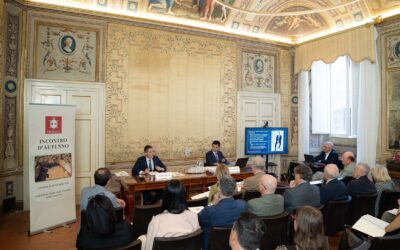
“The Past is the New Future”: this was the title of the conference that Daniele Pitteri (marketing and communication expert, general manager of the Modena Visual Arts Foundation and member of the Scientific-Cultural Observatory of the association) held in Florence on April, 4th at the Grand Hotel Baglioni, on the occasion of the Spring Meeting organized by the Italian Historic Companies Association.
Quoting an interview given by Giuseppe De Rita (president of Censis) to the newspaper “Repubblica” on the concept of “History’s value” (“We have lost the future even before we lost the past”), Pitteri underlined how, starting from great crisis of 2008, Italian companies have progressively reduced their time horizon. “Rushed by the urgency of meeting the demands posed by the crisis, they have increasingly focused on the here and now, driven by the need to survive in a very uncertain and destabilized market,” Pitteri said, “But for a company, focusing only on the present and the imminent future means departing from the very idea of making business, connected by its very nature to a vision of the future that is essential for its success. The entrepreneur must know how to look far ahead, otherwise death is his destiny, “precisely because”, added Pitteri, “the narrowing of the temporal horizon implies a cognitive narrowing of the retrospective gaze on the past. In other words, the inability to rationalize the future is connected to the emerging inability to reflect on the past. Without a sense of the past there can be no vision of the future”.
With reference to the more than a hundred-years-old brands that are part of the Italian Historic Companies Association, Pitteri said that “the history of a company is an essential tool needed to shape the future, a prerequisite for its success. We need to reflect on the past, building on the heritage of experiences, research, technologies, values, and, above all, products, and incorporate it in our idea of development. As a marketing tool, the awareness of the past and, therefore, the valorization of its heritage is a fundamental asset, a lever to be actively used to build and solidify the relationship with consumers”. Still talking about historic brands, Pitteri concluded that “they are intrinsically innovative. They don’t need to come up with innovations and technologies in order to restate their heritage. They just need them to communicate it. And by communicating it, they not only reaffirm their own distinctive identity – unique and, at the same time, different from all the others’ – but they promote engagement and trust through a symbolic system with enough pull to touch the emotional strings of their marketing targets. Because promoting one’s heritage does not simply mean having a story, but having stories to tell. Which, in the era of storytelling, means having the perpetual chance of engaging different targets and different generations on an emotional level, reaching beyond the borders”.