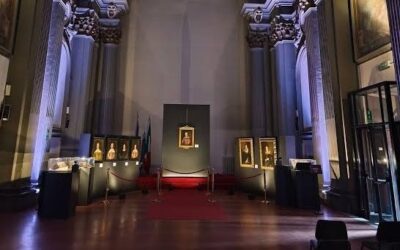
A history inside the history that finds its real and metaphorical origins in the wonderful Region of Calabria. A very interesting story, the Amarelli’s one, that started at the beginning of the XI century and continued during the centuries among crusades, literary commitment and agriculture in their large landed estates.
Old records testify that Amarelli’s Family was interested in the roots of a particular plant which grew wild along its wide latifundia since sixteenth century. Its name was liquorice, scientifically called glycyrrhiza glabra, that means “sweet root”.
In 1731 Amarelli’s established a “concio” one of the first pre-industrial organization in order to extract the juice of this beneficial plant.
So, shiny, black liquorice was born for children’s pleasure and for everyone who enjoyed eating a very natural product.
After three centuries the Amarelli Company – member of “les Hénokiens” which consists of the thirty-six family-owned companies all over the world that are hundred years old at least still produces, with exclusive working methods, a very high quality liquorice which can be eaten pure, soft, sugar-coated or tasted as delicious aroma for small nougats, brandy and spirit.
The revival of this unique history can be found in “Giorgio Amarelli’s Museum” in the historical family residence. “Giorgio Amarelli’s Museum” was awarded the “Guggenheim Culture and Business Prize”. Also a stamp was dedicated to it concerning “ The Italian Artistic and Cultural Heritage” that had a print run of 3.500.000 copies.
A visit here means to know a rare entrepreneurial experience strictly linked to the economic history of its region and a perfect combination between an excellent craftsmanship tradition and an updated technology.
The museum is housed in a historic 15th century residence that is the centre of the Amarelli family interests. Beyond the atrium, where carriage wheels, old bicycles, lanterns and the uniforms of coachmen and footmen are displayed, the family’s history is presented through a series of engravings, documents, books and vintage photographs. The centre of the gallery exhibits the history of licorice and the traditional system of its production, from the root bales, to the manual tools, to the bronze and porcelain moulds, up to the first experimental machines. There are also many documents about administrative procedures from the 18th and 19th centuries: manufacturing trade journals, accounting books, payments records and correspondence between manufacturers and government authorities. An old shipping office is also reconstructed.
At the end of the gallery there is the reconstruction of a 19th-century sales outlet, with practical objects and packaging in production at the time and on the other side there is a window that overlooks the gallery of the modernity. Among ancient electricity poles and in the light of old Edison bulbs the history of the carried energy takes place through the revolutionary transformation of the companies’ organization and, in particular, of the Amarelli “Concio”.
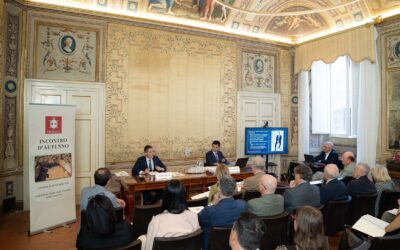
Rassegna stampa: Incontro d’Autunno 2026 a Siena
La Nazione (Ed. Siena) – 23/09/2026 "Unione delle imprese centenarie: Incontro a Siena e visita a Fiore" L'articolo presenta la tappa senese dell'Incontro d'Autunno dell'Unione Imprese Centenarie Italiane, tenutasi venerdì 25 settembre presso Confindustria Toscana...