The bees of the Torah – silent and invisible – roam relentlessly among the bookcases in this modern bookshop, which is so luminous that it seems to be perpetually kissed by a ray of sun. They are ready to ‘suck up’ other precious honey from the books before flying out from under the open gallery of Via Grande, formerly Via Ferdinanda or Rue Napoléon, towards the sea, towards far-away worlds.
The Bees of the Torah is the book that Emilio Isgrò wrote in 2001 to celebrate the reopening of Salomone Belforte & C., the Jewish publishing house in Livorno, founded in long-ago 1805 and currently boasting more than two hundred years of illustrious and tumultuous history. The bees of the Torah are the Jews who draw from the book – a supreme form of cultural comparison – the vital substance to be circulated to the various populaces. But the bees, much more extensively, are also the many vigilant clients in whom this trademark, generation after generation, has succeeded in fostering the supreme interest of mortals: namely, reading.
It was in the very early years of the 19th century. Napoleon was crowned emperor of France and king of the Kingdom of Italy. In Livorno, an epidemic of yellow fever occurred on a Spanish ship, while the Napoleonic Code put Jews on the same level as other citizens. A student of 28 belonging to the Jewish community of the city, Joseph Belforte, printed a book of prayers entitled Selichot (penitential orations) in Hebrew at his own expense at the typography of Elieser Sadun. This was the beginning of an extraordinary publishing adventure for the Belforte family.
A few decades later, his son Salomone founded his own printing shop, the S. Belforte & C., and set up its head office on the 5th floor of a building in Via Serristori. He obtained authorisation from the central government in Florence to print exclusively works in the ‘Hebrew idiom’ (the activity in Italian would start in 1890). These works soon made a world tour, and the publishing house in Livorno became an essential point of reference for the Sephardic community and for the entire Jewish culture of the Mediterranean: from Turkey to Greece, from Lebanon to Syria, from Iraq to Egypt, from Tunisia to Algeria, and from Morocco as far as India.
Hebrew texts, but also a production of books that ranged from textbooks to children’s books, from science to novels. The Salomone Belforte firm – with Giulio, and then with his sons Guildo, Aldo, Luigi and Gino – published authors of great prominence, such as Salgari, De Amicis, the poetess Neera, and availed itself of remarkable illustrations by Fattori, Corcos and Micheli (teacher of the young Modigliani). Its splendour was inevitably obscured by the racial laws of 1938, which obliged the family of publishers to change the name to “Società Editrice Tirrena”, until the bombings completely destroyed the activity of the printing shop (this was transferred to Navacchio at the same time as two bookshops were opened in Castiglioncello and Collesalvetti: places of refuge for many people from Livorno).
The post-war period is recent history for this ultra-centenarian firm, which never gave in, no matter what sort of difficulties it encountered. First there was the sale in 1961 of the typographic characters to the Mintzer company of Tel Aviv; then in 1964, the typographical activity was resumed with the use avant-garde machinery, among which was a two-colour rotary press, the first of its kind in Livorno. In the 1980s, there was the expansion to new publishing horizons (pedagogy and psychology, texts on scholastic parlance and learning), while, in a series of encounters, the bookshop witnessed the passage of personages such as Piero Chiara, Carlo Cassola, Indro Montanelli, and Roberto Gervaso.
In 2001, having re-introduced the original name of Salomone Belforte & C. with the entering into the proprietorship of the art-gallery manager Guido Guastalla (the nephew of Guido Belforte) and having renovated the premises in Via Grande, the firm finally resumed its publishing activity in the Jewish sector by publishing important texts of various types on Judaism, works by Shmuel Trigano, an unpublished tale by Sholem Aleichem entitled “Cantico dei cantici [Song of Songs]”, presented by Elena Loewenthal and illustrated by Emanuele Luzzati, in addition to three volumes on the cycle of Jewish life (birth, Bar Mitzvah, matrimony), all of which can be personalised at the client’s request.
It is enough to exchange a few words with Guido Guastalla, fully sharing also certain nuances of political philosophy and thoughts as a liberal 17th-century Whig, to realise the love that this firm has for Livorno, for its people, for a culture without boundaries.
The simplicity of the bookshop’s 1950s style furnishings, its rich bookshelf reserved for classical literature (a section that is all but impossible to find elsewhere), the extreme care taken with the displays that are so far from modern and confused clichés, all make the Salomone Belforte & C. bookshop a special and harmonious oasis of good reading. Here, choosing a book is a delight for the eyes, which are greedy to learn, to suck up the ‘honey’ of knowledge. Belforte’s clients, like little bees, know this. And they will always be ready to publicise it to the world.
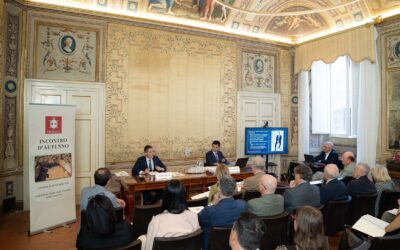
Rassegna stampa: Incontro d’Autunno 2026 a Siena
La Nazione (Ed. Siena) – 23/09/2026 "Unione delle imprese centenarie: Incontro a Siena e visita a Fiore" L'articolo presenta la tappa senese dell'Incontro d'Autunno dell'Unione Imprese Centenarie Italiane, tenutasi venerdì 25 settembre presso Confindustria Toscana...