(m.mas.) On the façade of the small church of San Miniato, there is a memorial plaque dated 1953: “I am grateful to the Lord for letting me be acquainted with this ‘little city’, which is a true source of peace and love”.
The gentle memorial engraved in the stone is by Giorgio La Pira, a great politician who was well acquainted with this place and appreciated its religious fascination. Truth to tell, the ‘little city’ is a delightful medieval village in Tuscany, located on the most classic hills of Chianti.
It is called Fonterutoli (from the Latin “Fons Rutolae” and “Fons Rutilant”), and seems to have been built in accordance with a magnificent legend: at the beginning of the 13th century, it is said to have been the boundary point of the provinces of Siena and Florence. To define the geographical dispute once and for all, there was reportedly a foot race between two knights, one from Siena and the other from Florence, and the place in which they encountered each other. The departure was supposed to be at cockcrow, and the Florentines chose a thin black cockerel that had been starved, so that it crowed continually. It was thanks to the Black Cockerel that the boundaries were extended to this point, at a short distance from Siena.
Between history and legend, Fonterutoli – a few fortune-kissed souls who lived in the ups and downs of Roman streets – is still very much linked to its past, which today has been purged of ancient rivalries. The past that counts is that of the Mazzei Marquises, owners of the Castle since 1435, twenty-four generations of whom have dedicated themselves to the top-quality production of one of the world’s ‘great’ labels.
However, the past was a very dynamic one, and it is easy to notice it during a visit to the magnificent late 16th-century villa, surrounded by the wood, formal garden and, obviously, the famous vineyards. “We cannot make wine nor live only on history,”say the Marquises “Innovation is fundamental, and one must believe in it. We were the first to imitate the more precocious vine types of Merlot and Cabernet and to work on the Sangiovese clones. We have just recently inaugurated a very modern wine cellar. And it is here that the first experimental olive press in Italy originated: the United States arrived only afterwards…”.
Cherished by the olive trees and by 120 hectares of vineyards, the Mazzei properties include the specific zones of Fonterutoli, Siepi, Badiola and Belvedere, all inserted within a very difficult territory of calcareous rock with a prevalence of alberese [a type of limestone rich in marl]. From a single hectare are produced 40-42 quintals of grapes that widen the satisfied smile of our host: “Quantity and quality are a difficult marriage to make,” explain the current descendants of the noble family: Filippo and Francesco (they accrued their experience, respectively, at Findomestic and Barilla) and Agnese, an architect. They are complemented by the experience of an ‘outside’ winemaker of the calibre of Carlo Ferrini.
In addition to being their enviable summer residence, Fonterutoli is the pulsating heart of this more than one-hundred-year-old enterprise. Farms and wisdom produce ‘powerful’ and aromatic Chianti wines of evocative power, young in their robustness. We are talking about Castello di Fonterutoli (Sangiovese refined by the modest presence of Cabernet Sauvignon), Fonterutoli (with minimal additions of Malvasia Nera, Colorino and Merlot), the highly original and sought-after Siepi, Poggio alla Biodola (a versatile wine enhanced by an altitude of more than 500 metres). The properties of the Mazzei Marquises are also developed in the Maremma, near Montiano, where the Belguardo estate rises (35 hectares of warm and enveloping ‘reds’: Tenuta Belguardo, Serrata and Bronzone, even if “we have a white in mind”), and in Sicily, at Zisola, near Noto, a spectacular territory that produces an elegant, full-bodied wine.
Customers live all over the world (26% in Europe, 25% in the USA & Canada, 20% in Italy), but new oriental frontiers are growing (Thailand, Singapore and, above all, Russia). Constant internationalisation, constant innovation. By simply going down the side of the small riding ground and descending downwards into the basin, an architectural spectacle – almost embarrassing due to its very avant-garde nature – captures guests. This is the new wine cellar: 4 years of work, 14 billion euros of investment, and designed by Agnese Agnese. Set out over two underground levels, it has a large window with a view over Siena and Monteriggioni, small vats for winemaking (one for each vineyard), and a wine cellar with a rock wall on which spurts – as though by magic – spring water, thus favouring humidification. After almost 600 years, “Fons Rutolae” continues patiently to bless the ‘little city’ of wine.
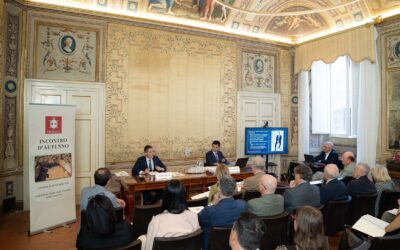
Rassegna stampa: Incontro d’Autunno 2026 a Siena
La Nazione (Ed. Siena) – 23/09/2026 "Unione delle imprese centenarie: Incontro a Siena e visita a Fiore" L'articolo presenta la tappa senese dell'Incontro d'Autunno dell'Unione Imprese Centenarie Italiane, tenutasi venerdì 25 settembre presso Confindustria Toscana...