(m.mas.) Each generation has its own tonality. Yesterday, it was the black and white of vat rooms/wine cellars, of dusty country roads, and of carts used for transportation, faithful witnesses to human sacrifice and ingenuity. Today, there is the more brilliant green of the Sienese hills that serve as a border to the almost diaphanous beauty of the new management centre. The common denominator of four generations of skilful vine dressers is a typical Tuscan red. It is the unmistakable colour of Cecchi’s enthusiasm for wine, of a more than one-hundred-year-old business that has its roots in an ancient history.
The first pages were written by Luigi Cecchi towards the end of the 19th century, more exactly in 1893, when he decided to undertake the activity of palatista, i.e. a taster and mediator of wines. Such was his success that, within the span of about twenty years, the wine-making firm that originated at Poggibonsi had already become extremely well-known, not only in Italy, but also in the rest of the world (from Switzerland to far-away Brazil).
The genetic resourcefulness and vocation for production and for its ideal marketing did not delay in showing up in Luigi Cecchi’s descendents. First, his oldest son Cesare, then his son Luigi, created the prerequisites for an international exploitation of the trademark. The operative base was transferred to Castellina, and the traditional properties were enlarged with three other holdings in Tuscany – divided up between the zones of Chianti Classico (Villa Cerna), San Gimignano (Montaùto), and the Maremma (Val delle Rose) – and one in Umbria (Alzatura, in the zone of Montefalco).
Today, Andrea and Cesare – Luigi’s sons: the former takes care of the production, while the latter sees to the marketing and administrative part – are in charge of a company that has its strong points in dynamicity, the quality of its products, and historic savoir faire. The result? Winery Cecchi has a consolidated turnover of about 30 million euros (12.5% of which is directed at constant investments) and an overall production of 7 and a half million bottles (60% of these cover 50 foreign markets, an indubitable datum of the universal appreciation for these wines).
Like all successes, success is not due to chance. And the same thing can be said for Cecchi. It grounds the prerequisites and its reasons in the link with the past, with the territory of origin and belonging, and in an ability to know how to adapt to new scenarios with a serene spirit of innovation. Those of the Third Millennium do not seem to have caught the Cecchi trademark unprepared. Quite the opposite.
The diversification of the vineyards, and thus of the production, is an example of excellent and enlightened entrepreneurship. At Castellina in Chianti, 205 hectares (90 of which are planted with vines) express the explosive strength and elegance of the Villa Cerna Chianti Classico. The Castello Montaùto agricultural estate, in the vicinity of San Gimignano, bestows on the most demanding palates an exquisite Vernaccia and a choice Extra-Virgin olive oil. Moreover, the area is partly devoted to an experimental vineyard, in collaboration with the Faculty of Agriculture of the University of Florence and the Vernaccia Consortium. The present-day 90 hectares of the Val delle Rose estate, in the Morellino di Scansano DOC zone in the locality of Poggio alla Mozza, grow various clones of Sangiovese and other red-grape varieties of an experimental nature, together with a smaller area of Vermentino di Maremma, with a production of 300,000 bottles (among which is the famous Morellino di Scansano DOC, in the vintage and reserve versions). Lastly, there is the Alzatura estate of Montefalco in Umbria, with regard to which the Cecchi family members – after a long experience linked to Sangiovese – decided to challenge itself by taking an interest in another autochthonous grape variety: Sagrantino (and it is here that the Montefalco Sagrantino DOCG and Montefalco Rosso DOC originated, for an annual total of about 66 thousand bottles)..
“I believe that another of our estate’s strong points is its family character, “affirms Cesare Cecchi. “It permits us to make medium- to long-term plans, differently from the big multinationals. And the estates with a longer temporal horizon, also in terms of investments, have shown themselves to be the healthiest and most determined ones, particularly during difficult periods like the present one.”.
Finally, with a perfectly oiled distribution on the international level, particular attention to the relationship with the human resources, a continual exertion of scientific research and of technological adjustment, the attentions of Wintery Cecchi have, almost inevitably, lingered on the plane of the estate’s image. Confirmation arrives from the new winery in Castellina in Chianti – which houses the management centre and the tasting room, together with premises dedicated to artistic exhibitions. The entire complex is signed by the architect Riccardo Rosi, in collaboration with two icons of “Made in Italy”, namely Poltrona Frau and Targetti – a strategic and spontaneous expression of this family estate, which has succeeded in finding its ideal equilibrium amid ancient skills and the modernisation process. It has time to leaf through the black and white photos of the first insignia of the 19th century and the hand-made straw-covered flasks. And it can still dream about the colour tonalities of its own future.
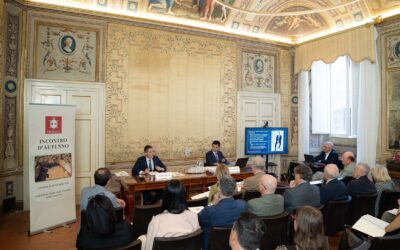
Rassegna stampa: Incontro d’Autunno 2026 a Siena
La Nazione (Ed. Siena) – 23/09/2026 "Unione delle imprese centenarie: Incontro a Siena e visita a Fiore" L'articolo presenta la tappa senese dell'Incontro d'Autunno dell'Unione Imprese Centenarie Italiane, tenutasi venerdì 25 settembre presso Confindustria Toscana...