(m.mas.) From the robust spool, graceful hands accompany the straw thread towards a Grossman machine of the 1930s. Solid and precise like its name, this German sewing machine, produced in Dresden, enters into the ‘starting process’. Worked in concentric circles, the straw thread will slowly take shape. It will be refinished, modelled, and ironed on wooden head blocks, and then embellished with ribbons, braids, buttons and other ornaments. It will become one, one hundred, one thousand hats. Light and soft. In intense and elegant colours. They will be worn by men, women and children, whether famous or not: from Princess Caroline of Monaco to Riccardo Muti’s wife, Chiara, passing through the film sets and Hollywood stars down to ordinary people who, much more simply, love an accessory that is the eternal symbol of discreet distinction.
And it is easy to succeed in being distinguished from the others when the hat in question is a product of Linea Greve, the griffe linked to the more than one hundred-year-old firm of Signa which, in long-ago 1875 and through four generations, has invented an unmistakeable style for the ‘heads’ of millions of people.
To tell the truth, the firm was created by Felice Marinesi right where the seat is still located today, in Via della Manifattura, a short distance from Signa. But the two partners, Fantacci and Grevi, soon entered the firm: if the former diversified the activity (by working in knitwear, but also becoming pioneers in importing the Rayban and Parker trademarks to Italy), the latter dedicated themselves from the end of the 19th century on to the straw and hat sector. Great-grandfather Attilio began, grandfather Silvio and grandmother Ada (the designer of extraordinarily successful exotic lines) continued; Alfonso Grevi unearthed new horizons for millinery together with ‘uncle’ Beppino, the French representative for the family products.
Today, the business is in the hands of Alfonso’s three children: Giuseppe, Silvana and Roberta. The latter is a designer and the soul of the firm, a sort of grandmother Ada of the 21st century, a concentrate of pure creativity. It is also thanks to them that the Grevi trademark has recently been able to be changed, remaining faithful to its own artisan skill but intuiting and travelling a different path in the production field. As suppliers of great trademarks, the Grevi family have thus decided to launch their own fashion line. “We noted that, at times, our hats were even copied,” Giuseppe Grevi explains, “and we said to ourselves, ‘why not realise our own Grevi Line?’”.
In view of the prerequisites, even this time success has not delayed in arriving. With an exponentially increasing number of clients (from 50 to today’s one thousand), Grevi is being successful in the face of the international crisis, with a consolidated turnover of 3.5 million euros. It offers work to about 45 employees (between permanent workmen, collaborators, and female home workers), and exports on almost equal percentage terms to two large market areas: Japan and the United States on the one hand, and Italy and Europe on the other. When visiting the 1300 square metres of the Signa factory, we run into a many-coloured picture of one thousand heads and the same number of colours, and have the impression of being in pleasant company. Small and large hats, elegant and sporty, different materials and typologies: felt, shearling, Tuscan lamb. “Straw and millinery remain our trade and our speciality, however,” Giuseppe explains. “The secret of Grevi hats? The lightness and softness, two qualities made possible only thanks to great artisan skill and to a respect for the ancient work techniques.” Hats for all heads and for all pockets, because the prices range within a vast gap between 40,00 and 600,00 euros, up to the exclusive models, which arrive at price tags approaching 1.000,00 euros.
If the graceful hands of workers and precision sewers, punches, strings and ribbons seem to have done their job magnificently for 143 years, it must be said, however, that Grevi’s history has not always been fairytale-like. The company was bombed during the course of the war, suffered damage from the Arno flood in the 1960s, and was destroyed by fire at the end of the following decade. The Grevi family have always had the courage to respond to these adversities with the quality of their own products, with a spontaneous and symbiotic attachment to their territory of origin, and with a likewise indissoluble bond with their staff, they too having reached the third or fourth generation. “Reading great-grandfather Attilio’s memoirs, I have noted that several surnames are the same ones that our current milliners have…,” Giuseppe Grevi confessed with a touch of emotion.
It really should must be said: we take our hats off to you, the Grevi family!
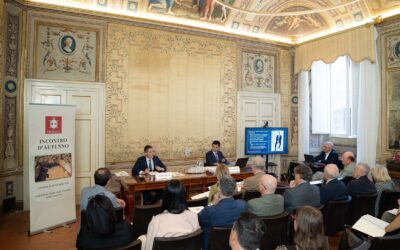
Rassegna stampa: Incontro d’Autunno 2026 a Siena
La Nazione (Ed. Siena) – 23/09/2026 "Unione delle imprese centenarie: Incontro a Siena e visita a Fiore" L'articolo presenta la tappa senese dell'Incontro d'Autunno dell'Unione Imprese Centenarie Italiane, tenutasi venerdì 25 settembre presso Confindustria Toscana...