(m.mas.) There is an enormous bronze – perhaps a monumental door, perhaps the umpteenth magnificent horse – coming out of the gates of the foundry in Via Corridoni in Florence, ready to be consigned to who knows which far-away customer in Europe or America.
We are in the curious Florence of special attentions of the second half of the 20th century, in the Rifredi district. People go out into the street and gather opposite the Fonderia Ferdinando Marinelli in order to be present at the ritual: another work of art has been completed, greets the building triumphantly, and appears so imposing in its dimensions that the tramcar company is obliged to dismantle the electrical wires in order to let the transport vehicle carry out its manoeuvres. Destination: the port of Livorno [Leghorn].
Amid the crowd there was also the young Ferdinando Marinelli Junior, a medical student at the time, who was lucky enough to have the same baptismal name as his grandfather, the founder since the beginning of the last century (i.e. in 1905) of the atistic foundry of the same name.
The episode, romantic in its popular sentimentality, is recalled at the beginning of the book by Maria Maugeri that follows the history of this Florentine historic enterprise, which is currently the only remaining one in the world in the sector of copies of great classics.
It is the story of a family that for three generations has dedicated itself with a craftsman’s wisdom and enthusiasm to the realisation of bronze fusions, utilising again the ‘cire perdue’ technique and the finishing procedures that had been used by Florentine sculptors during the Renaissance. The business was set up by grandfather Ferdinando Marinelli, who as an adolescent left Piegaro, a small town in the vicinity of Perugia, and landed on the banks of the Arno in search of work. Here, he gained experience by frequenting the foundries of Cusmano Vignali and the Gabellini firm in Via del Romito, acquiring fundamental technical and craftsman’s knowledge. He then opened his first shop in Via de’ Giudei, where he specialised in the “moulding box” technique for the realisation of buckles, bas-reliefs and medals. Times were ripe for the “big jump”: in 1919, Ferdinando Marinello took over the Fonderia Gabellini. An era of new splendour opened up for the Florentine tradition of artistic foundries.
The Fonderia Marinelli soon moved its field of interest to the sector of the fusion of large bronze works, and got itself talked about on the occasion of the excellent reproduction – to a scale of 1:10 – of Ghiberti’s Paradise Door. In the meantime, it began a profitable relationship of collaboration with the most important Tuscan (from Mario Moschi to Antonio Maraini; from Antonio Berti do Giueppe Graziosi; from Italo Griselli to Giulio Cipriani) and foreign (the American Abbott Pattison) sculptors of the 20th century. The foreign market was ready to be served. The occasion arose in 1929 when the Fonderia Marinelli was commissioned to execute the fusion of the ‘Wagon of the Pioneers of Montevideo’: this sculptural group had a 22-metre-long base and weighed 150 quintals.
Two generations have passed – those of grandfather Ferdinando and of father Marino and uncle Aldo – and at present Ferdinando Marinelli Junior is at the head of the Florentine firm. He operates with his 10 employees in the new seat in Chiano, at the boundary with the province of Siena, in an artisan area that definitely conforms more to the standards of modern production. Instead, the showroom is housed in the Bazzanti Gallery on Lungarno Corsini in Florence.
However, the workmanship methods at the Fonderia Artistica Ferdinando Marinelli are the same ones as those used during the Renaissance: long and delicate, while the orders become always more prestigious. “Everything is like yesterday, with the castings, the lotus moulds, the red painting. Except that we use a gas oven instead of wood faggots, and the methane-gas smelting furnace instead of coal. The firing at 700° may last for 10-15 days, including the cooling phases,” says Ferdinando Marinelli Junior, moving with cat-like agility among the plaster copies and gigantic machinery.
The results, here, are called orders: Europe, the USA, Japan, South America, Asia, Australia and Africa; the Holy Door of St Peter’s Basilica in Vatican City, the Monumental Staircases of the Vatican museums, the monuments for the US Department of Defence, the recent restoration of the Kremlin Palace in Moscow.
The work destined for Mile High Stadium in Denver, Colorado, is impressive: seven horses that are one and a half times larger than the originals, which represent the “Gallop of Brancos”. Marinelli Junior smiles at the compliments, looking at the wall where the black and white photo of the old foundry in Via Corridoni hangs. It is true: the population of Rifredi would have come back into the street to admire these horses.
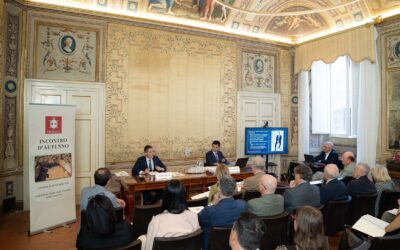
Rassegna stampa: Incontro d’Autunno 2026 a Siena
La Nazione (Ed. Siena) – 23/09/2026 "Unione delle imprese centenarie: Incontro a Siena e visita a Fiore" L'articolo presenta la tappa senese dell'Incontro d'Autunno dell'Unione Imprese Centenarie Italiane, tenutasi venerdì 25 settembre presso Confindustria Toscana...