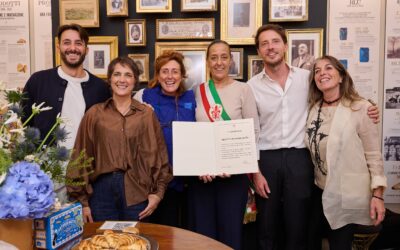
If it is true that ‘looks also count’, it suffices to observe the elegance of a package of the famous Panforte Fiore to let yourself be convinced by this delicious confectionary that makes you feel like Christmas.
This is an elegance that is combined with quality, both being ingredients that have slowly been improved over the centuries: passing from the medieval ‘vetus Senae’ to the ‘enlightenment’ of the 18th century, in order to arrive at the important inheritance that the Fiore trademark has succeeded in achieving and conserving for almost two centuries, starting in 1827, when it launched the ‘historic’ sweet towards its present international recognition.
Together with the Palio [bare-back horse race] and the Monte de’ Paschi bank, panforte [a rich but rather hard spicy cake made of candied fruits and nuts] is perhaps one of the most authentic and genuine symbols of the Tuscan city. Its origins are sunk in the antiquity of alleys, cloisters and mazes of streets designed in stone, where also the ancient spice shops rose: pharmacies of the past that were first ‘laboratories’ for one of the most famous desserts in the world.
Despite the fact that historic allusions speak of the appearance in Siena of its ancestor, ‘panpepato [spice cake]’ in long-ago 1205, it was only between the 12th and 16th centuries that panforte began to have a certain fame. This was dictated also by Siena’s important role along the axis of the Via Francigena.
The first work phases took place, in fact, in the back of spice shops, because an ordinance of the time prohibited the production of confectionary outside the enclosing walls. It also provided for the use of costly spices in the dough: a feature that conferred on panforte – packed in ornate boxes called ‘tefanie’ – a characteristic of exclusivity and Christmas rarity.
The ‘Farmacia Fiore’ thus originated in 1827 in the old premises of Via Garibaldi (today, it is located in Via Camollia), and in time was consolidated, linking its destiny at first to that of the Corsini family and then to the Dolcezze di Siena Group. Today Fiore is an important production reality in the area that employs over one hundred employees, but despite this it has not lost its artisan spirit and meticulous attention to the historicity and originality of the recipes.
In the meantime, the Fiore production has been enlarged with the addition of other delicious products that have arrived to keep ‘Panforte Margherita’ (more suitable to ‘female’ tastes: it was realized for the first time in 1879 in honour of the Queen’s visit to Siena) and ‘Panforte Oro’ (dark and rich, according to oriental terminology) company.
In other seasons of the year, seeing so many small well-ordered toy soldiers exiting from the modern machines used for production by Dolci Tipici Senesi, who set off in single file towards the patient hands of the workers and gift wrappings, creates a certain impression. These are the Almond Ricciarelli, Cavallucci or Biricuocoli, and Copate, light disks of nougat enclosed between two wafers.
Another painstaking work of selection and control awaits them before the cakes are ready to be wrapped (by hand) and appropriated for setting the tables of the world with happiness. If they were here, the old apothecaries of Siena would approve of all this without hesitation.
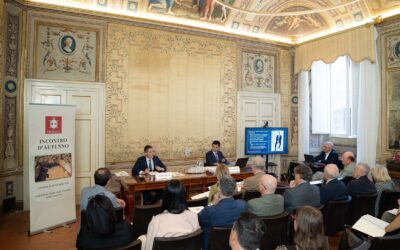
Rassegna stampa: Incontro d’Autunno 2026 a Siena
La Nazione (Ed. Siena) – 23/09/2026 "Unione delle imprese centenarie: Incontro a Siena e visita a Fiore" L'articolo presenta la tappa senese dell'Incontro d'Autunno dell'Unione Imprese Centenarie Italiane, tenutasi venerdì 25 settembre presso Confindustria Toscana...