(m.mas.) “Rien sans peine”, nothing without effort, nothing is given. The motto that appears on the coat of arms of the Ricasoli family – testifying to the unification of the three branches of the family: Brolio, Meleto and Panzano – seems to leave no doubts in this regard, and sounds like a judgement on the eternal sacrifice to which human beings are called.
Arriving on this uncontaminated Tuscan hill and admiring the harmonious beauty of the landscape, the doubt of not completely sharing the said motto arises, and one remains open-mouthed for a moment. Perhaps at Brolio something special has been ‘given’ in kind: a fairy-tale scenario that has as its progagonist a magnificent castle ‘crowned’ with excellent vines that have produced an ante litteram Chianti Classico which still today is served with white gloves all over the world.
Certainly, the ‘efforts’, above all those linked to questions of geopolitics – supported in the past by the noble Ricasoli family, owners of the castle since 1182 and dedicated, according to certain sources, to the vine-growing and wine-producing activity since the 17th century – can be seen by everyone. “Quando Brolio vuol brogliare tutta Siena fa tremare” [when Brolio wants to scheme, all of Siena trembles], people of the region used to say when recalling the historic rivalry with the Sienese. We can truly believe this if we observe the two wings of the castle (one, made of red bricks, faces towards Siena; the other, made of stone, in the direction of Florence): faithful architectural documents of a strategic excellence, imperious bastions of long-ago epochs, when alliances were both sacred and violable.
Certainly, the ‘efforts’, above all those linked to questions of geopolitics – supported in the past by the noble Ricasoli family, owners of the castle since 1182 and dedicated, according to certain sources, to the vine-growing and wine-producing activity since the 17th century – can be seen by everyone. “Quando Brolio vuol brogliare tutta Siena fa tremare” [when Brolio wants to scheme, all of Siena trembles], people of the region used to say when recalling the historic rivalry with the Sienese. We can truly believe this if we observe the two wings of the castle (one, made of red bricks, faces towards Siena; the other, made of stone, in the direction of Florence): faithful architectural documents of a strategic excellence, imperious bastions of long-ago epochs, when alliances were both sacred and violable.
Secondly, we could say that there are the more strictly wine-related efforts. These are the ones that have obliged the historic enterprise to deal daily with a very particular and complex terroir – abounding in skeleton, with uneven levels of 300 metres and the presence of red clays, alberese, and marl – but ideal for those types of vines that love ‘difficult’ environments.
At Brolio, the Ricasoli properties extend over 1200 hectares. Many of these are covered with woods, while 240 h are planted with vines (high density, with 6500 plants per hectare) and 26 h are dedicated to the cultivation of olive trees. Most of the vineyards (about 150 h) consist of plantings of Sangiovese; the rest are red-grape (Merlot, Cabernet Sauvignon, and Canaiolo) and white-grape (such as Chardonnay and Malvasia del Chianti) vines.
Noble, ordered rows of vines give rise to precious labels (for a total of 2 million bottles a year), such as the refined Castello di Brolio, a selection of Chianti Classico grapes that are aged in barriques and bottle-refined, produced with the seasonal excellence of Sangiovese; ‘Brolio’, it, too, Chianti Classico: a typical wine with a tasty drinkability; the powerful Casalferro, a Tuscan ‘IGT’ of great quality (70% Sangiovese, 30% Merlot); or else the Torricella ‘white’, a pure Chardonnay that takes its name from the vineyard that inaugurates the grape harvest.
Without ever losing sight of the classical quality and typicality of its own trademark, the Ricasoli family always and in any case looks to the future, taking as its example their ancestor, Bettino Ricasoli, the ‘Iron Baron’ and an outstanding personage of the Italian Risorgimento. He was Prime Minister with a passion for botany, and was the person who in the 19th century institutionalised Chianti Classico by preparing its original formula, after studying French vines and deriving inspiration from them for the ideal ageing of his wines.
Today, the estate (150 employees among those working in the wine cellar and labourers) – which has been managed by Francesco Ricasoli since 1993 – is working at a long process of innovation, characterised by the re-planting of the vines (still under way) and by a study of the ‘clones’ of Brolio (13 have currently been isolated). The latter is being carried out in collaboration with the Universities of Florence and Pisa: in 2008, it will involve 6000 more plants. Six thousand, like the number of barriques that illuminate the ‘Cathedral of Brolio’, the very fine wine cellar where the wine is aged using modern techniques.
The rest is pure and enchanting classicism. The isolated farm houses in the countryside reserved for guests (they have often housed members of the Belgian royal family), the ‘English wood’ of conifers that surrounds the bastioned enclosing walls of the castle, today a national monument inside which can be admired the Armoury where war strategies were discussed amid Flemish tapestries and magnificent lamps decorated with the family coat of arms. The motto “Rien sans peine” appears once again. Perhaps it is really true, even if today is a splendid spring day, and Siena – a tiny speck on the horizon – no longer trembles.
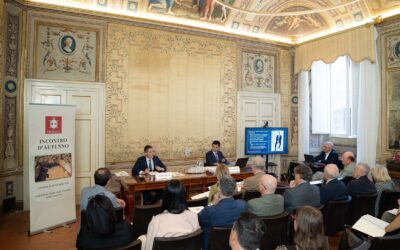
Rassegna stampa: Incontro d’Autunno 2026 a Siena
La Nazione (Ed. Siena) – 23/09/2026 "Unione delle imprese centenarie: Incontro a Siena e visita a Fiore" L'articolo presenta la tappa senese dell'Incontro d'Autunno dell'Unione Imprese Centenarie Italiane, tenutasi venerdì 25 settembre presso Confindustria Toscana...